Sunday, August 14, 2016

Log XXV - Artemis 1 (Equipment)

There are hundred and one things on board a boat that require maintenance especially when your boat is in a saltwater environment and it is not brand new. So you need to have a strong heart and mind to keep the boat in good working condition.

In my previous post on the maiden voyage, I had mentioned that the fuel gauge is faulty. Let us start with fixing that. First, you have to find where is your fuel tank and where the fuel outlet from the tank is. It is easier to find the fuel outlet because you can trace the fuel line from your engine to the outlet's position. And usually, the fuel gauge sender is near to the outlet.

Second, you will have to figure out how to access the sender. In my case, the sender can only be accessed from this pathetic small opening.


I cannot even barely see the sender, not to mention take out those corroded screws which are likely to be super tight with rust. Hence I will have to make my own access by coring a bigger hole. Hole saw of this size is not easily available and you will also require a bulky equipment to mount that hole saw. Since I do not have the luxury of working space and equipment, I will have to make do with what I have.

You can make a big hole by drilling many small holes like this.


You will only need a handheld drill and a file to smoothen the circumference.
This will be the outcome.

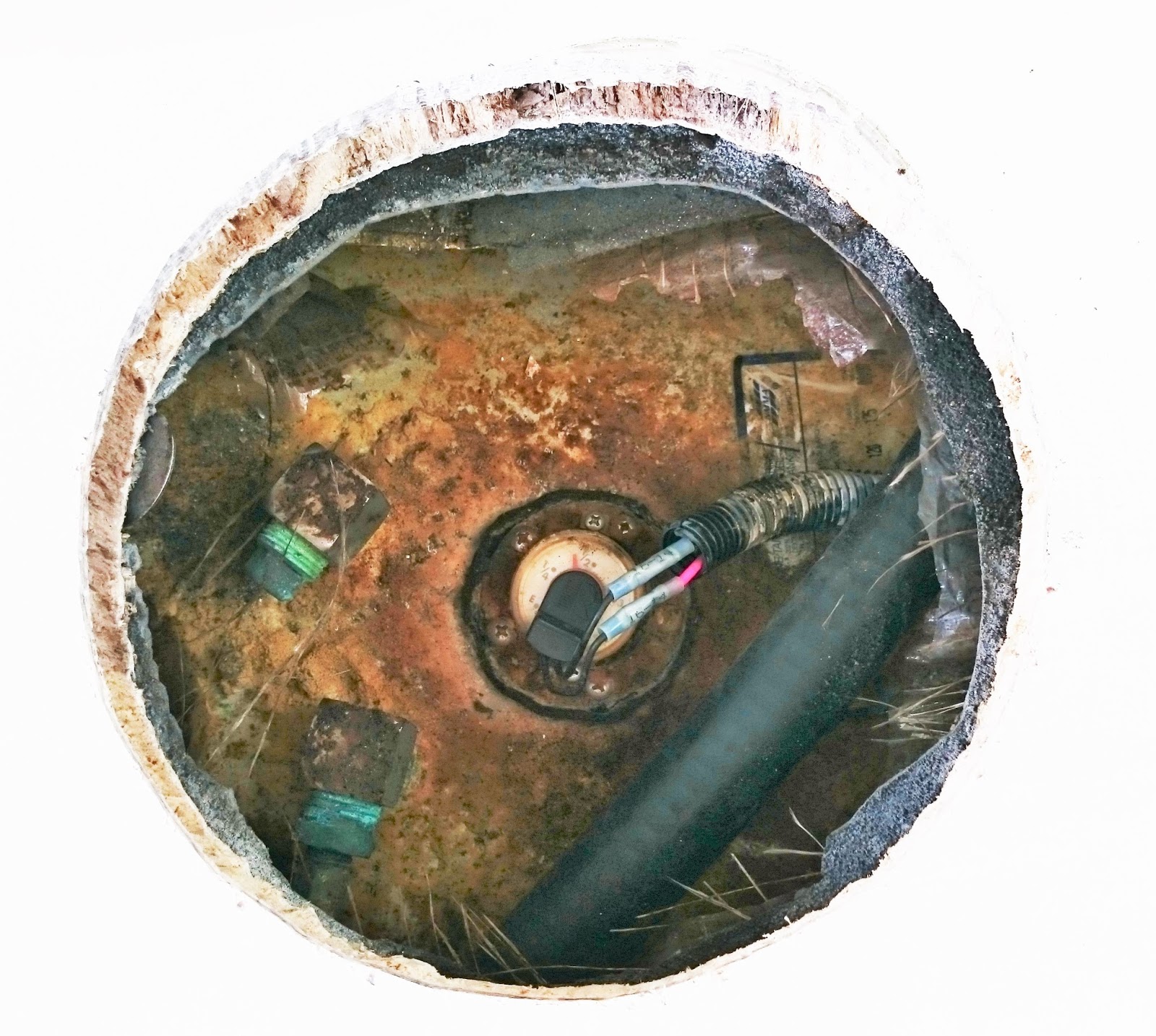


The sender can be clearly seen and easily accessible now. Remember to vacuum all the debris away before opening the sender as you will not want any dirt to fall into the fuel tank and clog up your fuel lines.

Sender taken out.


FYI, sender and the meter may not be compatible to each other. You may have to buy the sender and meter together as a set so that the meter can read the fuel level accurately. I changed both of them as my original meter is not compatible with my new sender. And because of this, as I have 2 engines, I will end up with 2 types of meter on my helm - one old and one new - which does not look nice. So I changed the sender/meter for my the other fuel tank too, though it is still working.

The new sender installed.


The next item on the list is the gas spring for my live bait well cover and external basin. The existing gas springs are not strong enough to hold the cover anymore. A light tap on the cover will slam it shut. This is a potential hazard for fingers which might happen to get in the way. So I have to replace those springs.

Cover hatch for bait well.


Cover hatch for wash basin.


This is one of two new gas spring installed.


Initially this sounded like a piece of cake job to me but it was not! In order to hold the hatch cover in place, the gas spring require a design load of 15 kg. To exert a force of 15 kg using your fingers while slotting it into the groove is no joke. It was really a good workout for my fingers installing those gas springs.

Last but not least, always remember to close your cabin hatch when you leave. If not, you will have to end up doing this after a rainy day...


This is the only time when you will prefer the sun to be as hot as possible.

And when you close the hatch, don't pull on the handle. Release the support by loosening the lock and let it closes by gravity. Otherwise, there will be one more thing for you to fix when the handle broke off...


In my next post, it will be the 'Last Days of my Engines'. Sob...

Saturday, May 28, 2016

Log XXIV - Artemis 1 (Loops and Circles)

This post is all about loops and circles. If you like things to look neat and tidy, here is one way you can organise your mooring ropes.


As you can see, I use a total of 6 ropes to moor Artemis at the marina. It might look overkill but if your boat can experience strong winds and waves in the berth, this is definitely necessary. I used to be stingy in the ropes by using a bare minimum number of three mooring ropes. And within 1 month, one of the ropes broke. Luckily someone saw the broken rope and helped me to tie the good end of it to secure back my boat. I still don't know who this kind soul is, but if not for this person, my boat might pin ball around in the marina.

On top of doubling the number of mooring ropes, I also upgraded the ropes to those black ones with build-in elastic bands. This elastic band helps to absorb the impact from the waves thus lengthening the lifespan of the rope and also gives more protection to the boat body. And of course this kind of rope is much more expensive than the normal white ones too.

My port side engine was very unstable. It would just shut off without any reason randomly. I suspect there might be problems with the fuel intake. So I checked the fuel tank outlet and found this bunch of 'circles' inside.

I do not know what are those, and how they got into my fuel tank. But hopefully the engine would be stable after removing this. Because if one of my engines suddenly breaks down while berthing, it can be quite a disaster. Just like what happened to my hand rail.


The boat spin out of control when one engine died suddenly and the hand rail got caught in between the pulpit and anchor of another boat, causing the base connection bolt of the rail to break off. I had to replace the connection with base fittings instead. But the rail base fittings come in standard angles and my deck is sloping, which makes the angle between the sloping deck and the hand rail an unique angle. So I had to cut a few rubber gaskets to fill up the gap after trying a few types of base fittings in vain.

Well the consequences could be much worst than a broken hand rail. Artemis was lucky to escape without any 'scaring' both to herself and to others.

Friday, May 27, 2016

Log XXIII - Artemis 1 (Pumps and more Pumps)

Can you give a guess how many pumps are there on Artemis 1?

Here goes the list:

Bilge pumps
1) Front
2) Mid
3) Aft
4) High water


Sanitation pumps
5) Pressure
6) Macerator


Water pumps
7) Water supply
8) Raw water
9) Bait well

There are a total of 9 pumps to maintain on board Artemis 1! Hopefully I didn't miss out any. These are not including those fuel and water pumps in the engines and generator.

Though the pumps are not critical in the operation of the boat but they are definitely necessary for your safety, and will give you lots of inconvenience if they break down during your trip. So take good care of them and check on them regularly.

Sunday, May 1, 2016

Log XXII - Artemis 1 (Hull Inspection)

I believe this will happen to all boaters at least once in their lifetime, it's just a matter of sooner or later when you get that bump onto your hull or props. During one of the exploration trips to the Southern Islands, which are notorious for their hidden shallow waters, we were cruising around Pulau Hantu when I felt the hull or props hit onto something. The first instinct was to look over to the side of the boat, and I could see sand and sea weeds being stirred up by the propellers.

The sounder was registering 4 meters depth and before I knew it, the depth shot up to 1 meter and followed shortly by the impact. Luckily I was travelling at a very slow speed of 5 knots when this happened, so hopefully even if there was damage it would not be serious. The boat behaved normally as I drove back to the marina.  After securing the boat, I dived down to check on the hull, propellers and rudders.

Both the props and rudders still looked in one piece and no damage on the hull was observed. After this incident, I think a diving mask is one of the necessities to have on board in case of any emergency inspection or work needs to be carried out underwater.

Since I was planning to paint a new layer of gel coat on the boat, it would be a good opportunity for me to inspect the hull when I lifted the boat up for polishing.


As the weight of my boat falls marginally below the capacity of the fork lift in the marina, we decided to bring her up during high tide to lessen the lifting height. So remember to check whether your marina facilities can handle your boat before purchase, or you will have to budget in additional costs for maintenance at another yard whenever you need an up slip.

After my first back breaking experience of polishing the boat's body, I decided to let someone else do the hard work for me this time, at a much higher cost of course. However I was not able to laze around either. I had to touch up on the anti-fouling paint on the props, rudders and localised spots on the hull.

You can see the contrast between the port prop and the starboard prop in this photo showing the before and after application of anti-fouling paint.

I also changed the anodes on the shaft, trim tabs and hull.

The shaft anodes still looked fine but it would be difficult for me to change next time, so they were replaced.


The trim tab anodes were in the worst condition which later I realised it might be due to the trim tabs not electrically bonded. I shall cover this in my later posts on the boat bonding and earthing system.


I was not able to find the exact hull anode available in Singapore and had to order a customized one to fit the screws. So I didn't change it since the condition still looked acceptable to me.

This whole operation took 3 days to complete. 
First day - up slip. 
Second day - hard labour. 
Third day - boat back in water again.

After the 3 days, the boat had a new polished look and luckily the bumping incident didn't cause any damage.

Monday, April 11, 2016

Log XXI - Artemis 1 (Anchor Rode)

Our fishing culture is quite different from the western countries. Fly fishing is popular in the west while we do lure fishing in rivers and lakes. When out at sea, the westerners like trolling while we are more into baiting and jigging. Trolling is almost non existence in Singapore.


Basically the only reason for outriggers to be installed on yacht over here is for aesthetics.

Anchors and rods are configured differently too. Generally US boats come with smaller anchors as they do not need to anchor in deep waters and they often use full length anchor chains without anchor ropes.

Singapore waters are littered with wrecks and anchoring the boat is crucial to fishing the wrecks effectively. Many wrecks are located at seabed depths of 30 meters or more, that means we will need at least 100 meters of rode to safely anchor the boat. A larger anchor will also be required to deal with the strong currents and winds in deep waters.

Other than being impractical and uneconomical to install 100 meters of chains, it is also dangerous to do so. Singapore port is well known to be one of the busiest ports in the world. If a tanker strays off its route and travels towards you. And it so happens that you have a fouled anchor due to the many reefs and submerged pipelines/ cables in this area, your boat will instantly become immobilized in front of the path of a few thousand tonnes of oil load.


The only thing you can do is to free your boat by cutting the anchor rope, but this will be impossible if the rode is all metal chains.

I did two modifications to my anchor and rode to suit the fishing conditions here.

I cut the original 30 meter metal chains into half and that will leave me with 15 meters of chain rode.


After that I connect it with 150 meters of rope by splicing. Splicing sounds complicated to me at first but after watching a couple of YouTube videos and reading the downloaded instructions from the internet, it is actually quite easy.

The next task is bit more tedious.

I use a cardboard to make the profile of the anchor retriever.

After that I pass the anchor and the retriever to a stainless steel fabricator for them to machine the retriever in stainless steel.

And this is the end product.

The purpose of this retriever is to enable the anchor to be pulled out of a fouled condition as illustrated by the diagram below.

 
When the anchor is wedged in between rocks or corals, it is very difficult to pull it out regardless of what direction you pull. But if we can apply the pulling force at the crown, the direction of the force will be able to dislodge the fluke.

A rope is used to secured the retriever and anchor together. When the anchored is fouled, the force of the boat will be able to break the rope, thus shifting the pulling force to the crown and release the anchor from the fouled situation.

I feel that this retriever device is a must for fishing boats that often anchor at spots with corals and wrecks. It not only save you money on buying a new anchor, it also enables you to break free your fouled anchor easier in an emergency.

Friday, March 11, 2016

Log XX - Artemis Catch

All the previous posts were on the problems and issues of the boat. Of course we need some breather from these headaches.

The catches on Artemis 1 are not so spectacular yet but I always learn something new after every trip. Very soon, Artemis will live up to her name as the Greek Goddess of Hunt.


Grouper is one the most common fish found in Singapore and they are tasty too. The only down side is that they do not usually put up a good fight.


I usually have luck with the red ones which are highly prized by the anglers here for their meat. I feel that they taste about the same as the normal groupers. Perhaps it is their striking red colour which resembles good luck to the Chinese that makes them much more expensive than other species.


The other common species here are the spanish flags. They are quite aggressive but somehow are underrated by most anglers.


I was lucky that some so my friends are very good at jigging so that they can try out the spots with their jigs. This was one of the time where we hit a school of giant herrings.


I was also glad that I managed to help one of my friends broke his record of landing a 1 kg fish with this sweetlip snapper.


I am still trying to find out where are the good spots and the feeding patterns of pelagic fish such as this diamond trevally,


Once a while, we would stop by one of the islands...

catch some small fish and cook them on the spot.

All these moments are priceless and there will be more to come...